
Against Tech Oligarchy
I've written a book! It's about tech worker activism and, relatedly, the rightward turn of Silicon Valley's ultra-rich—and it's coming out next month.

I’m very excited to share that I’ve written a book with my dear friend Clarissa Redwine called AGAINST TECH OLIGARCHY, out September 15th, and you can pre-order it here: https://againsttecholigarchy.com!
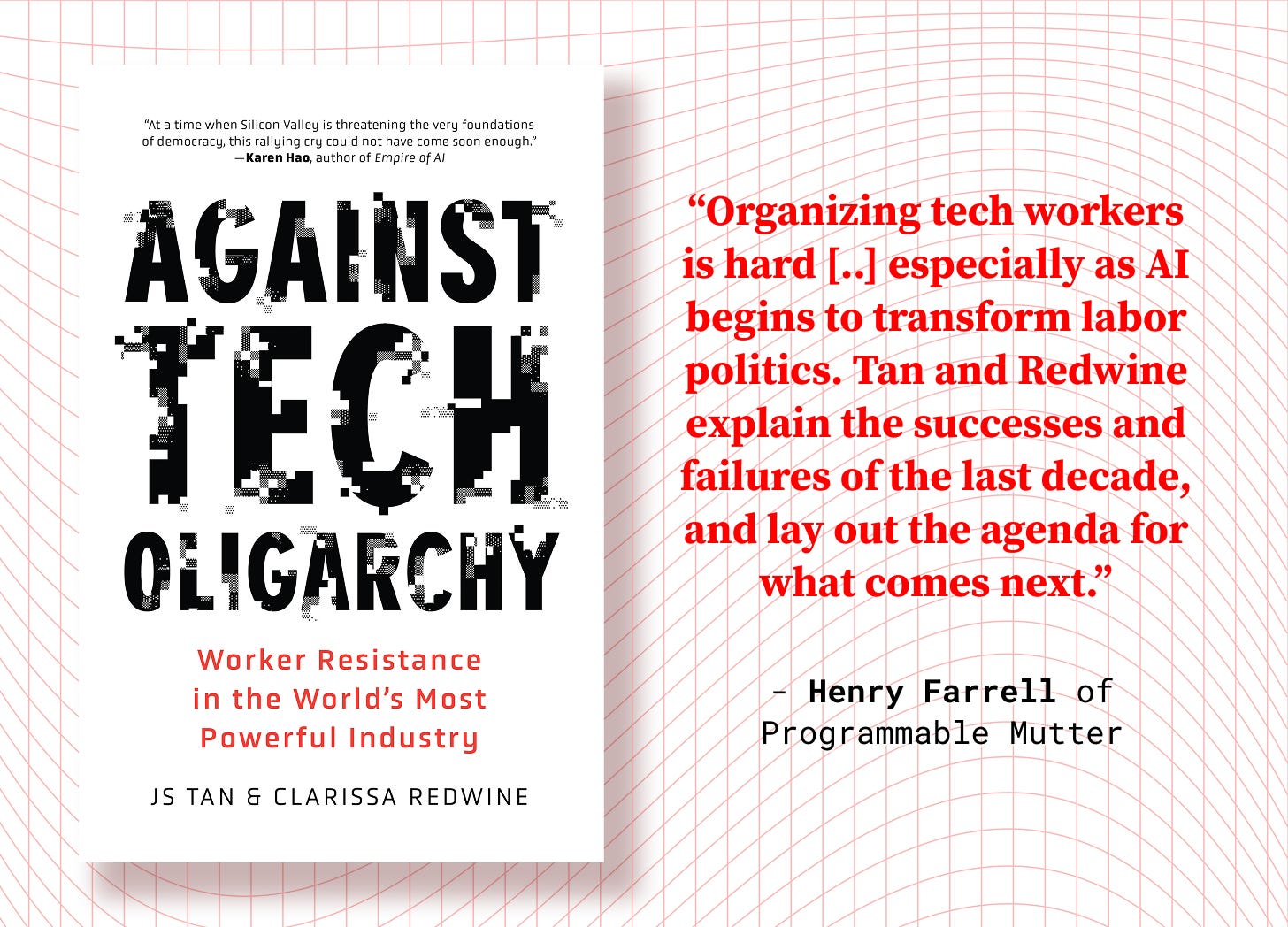
The book is a portrait of the tech worker movement, chronicling its rise, the effect it’s had on Silicon Valley’s labor politics, and also why—as of these past few years—it has fallen into a state of crisis.
For readers unfamiliar with said movement, what I’m referring to is the sudden explosion of labor organizing and political activism in 2018 by the tech industry’s own corporate employees, including engineers, designers, product managers, and other highly paid roles in tech. Prior to that year, employee protests in the industry were practically unheard of—and, in fact, most people would’ve laughed at the idea of such a well-off group of employees protesting anything.
But by 2018, these protests were suddenly everywhere, at big and small companies, and happening almost every week. As was breathlessly reported in across the American media landscape, tech workers organized walkouts, protested at annual shareholder meetings, challenged their bosses at internal all-hands events, and circulated dozens of open letters signed by tens of thousands of employees across the industry. These were, of course, the years of the Google Walkout (with some twenty thousand employees walking off the job), the fight against Project Maven, the fierce battles to cancel ICE contracts, and the sustained effort to stop the industry’s deepening collaboration with the Pentagon.
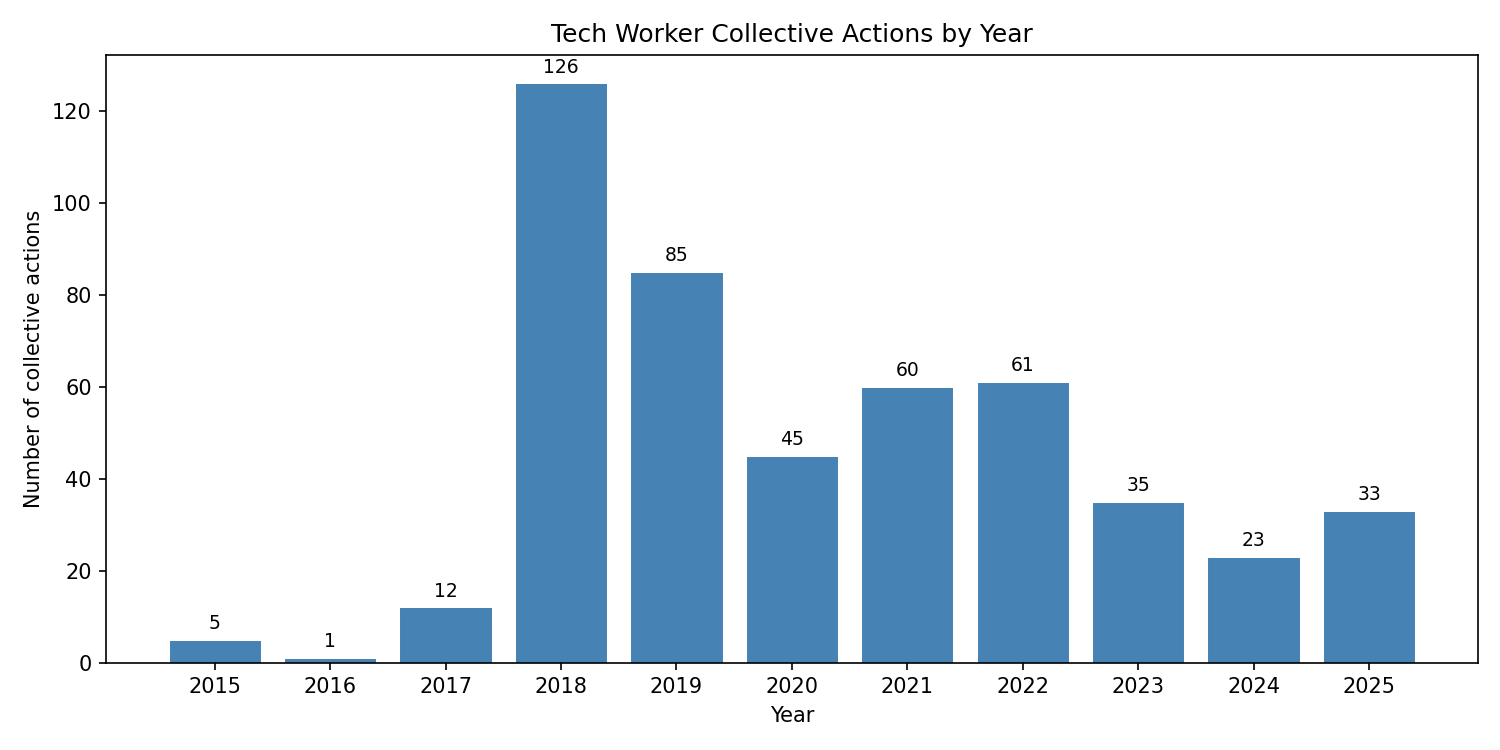
Since then, however, that movement has waned, and part of it is because the industry—and its open workplace culture—has changed significantly. Indeed, tech workers from a decade ago would hardly recognize the Silicon Valley of today. The socially progressive cushy jobs of the 2010s are now largely gone and have been replaced by a distinctly anti-woke 996 grind culture. Meanwhile, tech bosses have abandoned the Democrats and their liberal politics, growing instead much more comfortable with a cozy relationship with Trump and the Pentagon. In this new environment, dissent has become far riskier.
There are many reasons for these shifts. Perhaps the most critical is financial environment. The year 2022 spelled the end of the Zero Interest Rate Policy (or ZIRP)—an era in which interest rates were practically zero—which led to hundreds of billions of dollar wiped from the industry’s market cap. To stay profitable, tech companies started to cut on their largest costs: their employees, introducing for the first time since the dot-com burst a new era of layoffs in the industry (which I’ve written more about, here).
But the tech worker movement and these shifts in the industry are not unrelated, and, in fact, we draw a direct connection between them in our book. What we show was that as employee backlash intensified, tech’s bosses began to lash back and retake control over their unruly workforce. And in 2022, when the ZIRP era ended, they were given the perfect opportunity to do just that.
If the problem had just been financial, the layoffs would’ve been sufficient—each layoff was in fact handsomely rewarded in the stock market. But the attack on workers didn’t stop there. Tech bosses started to openly challenge the liberal, or “woke,” values that they believed had turned their own employees against them. This meant rewriting the DNA of tech’s open and progressive workplace culture: clamping down on political discourse on internal messaging platforms, shutting down DEI initiatives, eliminating AI ethics groups, and the like.
Elon Musk’s takeover of Twitter is one example of this: part of why he bought the company and then gutted its workforce was that he believed a “woke-mind virus” had infected its employees, whose ideological capture, in turn, resulted in what he believed was unfair censorship (of mostly rightwing pundits and occasionally himself) on the platform. Mark Zuckerberg followed a similar path, introducing a more “masculine energy” and “bro culture” into Meta, which he framed as a corrective to what he called an overly “neutered” corporate culture; this shift coincided with Meta’s rollback of DEI initiatives and its decision to end third-party fact-checking.
Industry thought leaders like Marc Andreessen and Alex Karp have also openly cited the tech worker movement as part of the need to detach the industry from its liberal culture. Andreessen explicitly linked his own radicalization to employee activism; he derisively said in a New York Times interview that tech workers were “going feral” and that tech companies were, as a result, “being hijacked to engines of social change, social revolution.” Karp, in his new book (which you can read my review of here), similarly portrayed the employees who protested military contracts at Microsoft and Google as entitled liberals corrupted by elite left-wing universities.
It may not be that every tech executive held these beliefs, but once key leaders began taking back control of their workplaces, it was hard for others not to follow suit. And so, by the time of the 2024 presidential election, many of the tech industry’s most influential figures had embraced this anti-liberal position, making Trump the perfect political partner for tech’s new radicalized billionaires.1
In essence, what we argue in Against Tech Oligarchy is that a key part of this broader shift in the politics of the industry boils down to a story of class struggle—how tech workers started to develop class consciousness in the late 2010s, what strategies they used to fight against their bosses, and how tech bosses have responded to (and radicalized against) their brave activism.
We know the tech worker movement well because some of the stories are our own. When I worked at Microsoft, I helped organize various open letters and internal actions to protest the company’s growing collaborations with ICE, the Pentagon, and Big Oil companies. Then, after being sent to Kazakhstan to help Chevron accelerate oil extraction using Microsoft cloud and AI technologies, I also blew the whistle on the software giant who was at the time trying to portray itself as a champion of the green transition. (Paris Marx interviewed me about this last year.)
For her part, Clarissa was a key organizer at Kickstarter where tech workers won the industry’s very first union. She was fired for her role in the campaign, but has continued to support labor organizing in the industry, becoming one of the most militant voices in the movement. Over the years, we’ve both stayed heavily involved with organizing tech: running trainings, bootstrapping campaign, and, at one point, even working for an international union as staffers to organize the industry.
For readers of this newsletter, the approach that this book takes would not be novel. Too often, we read about the tech industry from the stories and narratives of its founders and executives. But what I’ve hoped to do in this newsletter is to approach analyses of the tech industry by bringing in the perspective of its workers. That’s exactly what we do in this book as well. It tells the stories of the very people who built the industry, how they courageously came together to hold their bosses accountable, and how—in doing so—they’ve changed Silicon Valley forever.
You can preorder my book from this bookshop link, from your local bookstores, or wherever you buy books. Pre-orders really do matter. And for this book, it will determine whether tech workers—not just tech bosses—get to have their stories told to the world.
Employee activism was by no means the only factor behind Silicon Valley’s embrace of Trump, but it is often an overlooked factor, and one worth emphasizing.