
Why drinking is good for the economy
And what a sober generation might cost us.

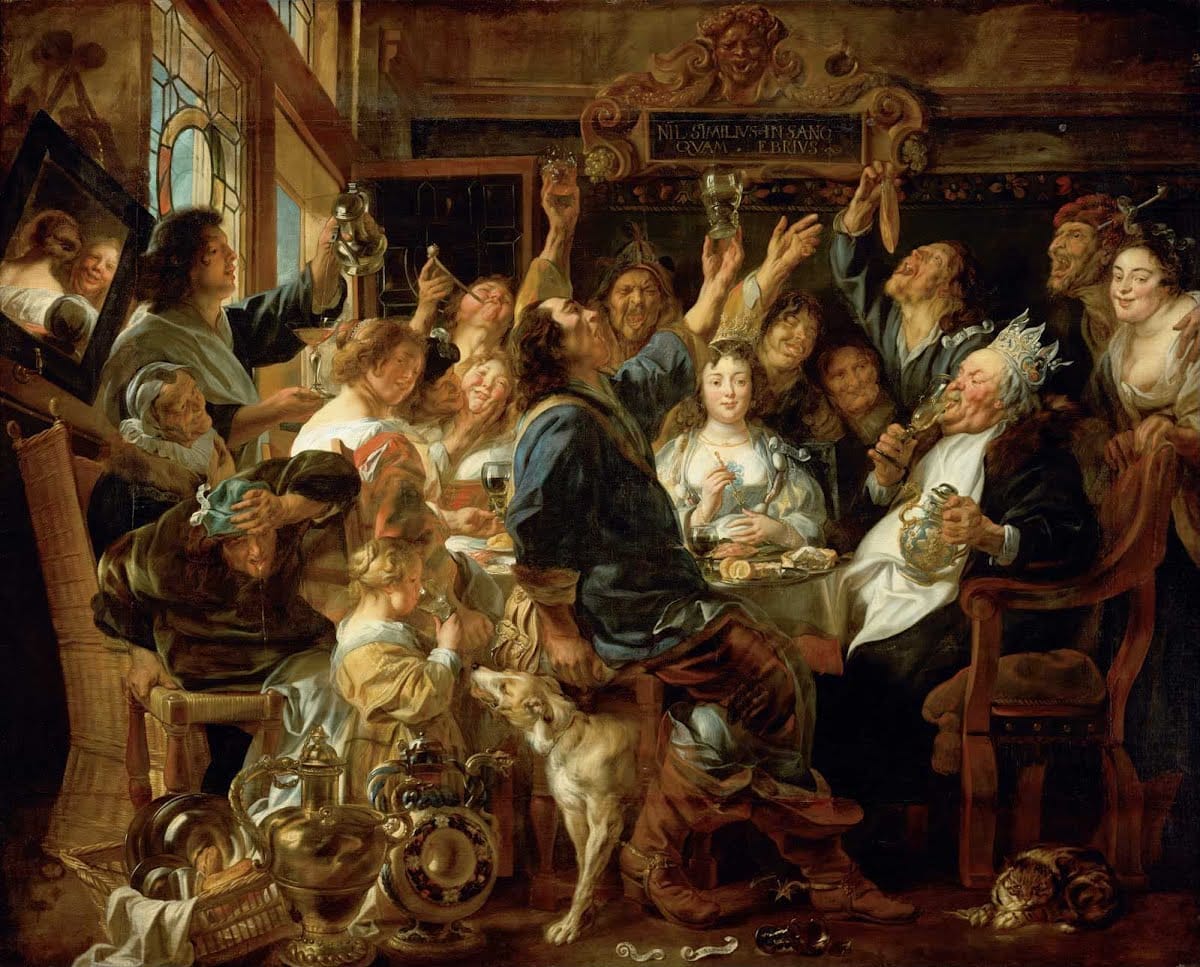
Last December, I was in Guiyang, in China’s Guizhou province, sitting in a private dining room in the city’s newest and most impressive mall. There were nine of us at a round table, including my friend who owns a beverage upstart and his sales employee, some regional distributors they were working with, and a supermarket procurement manager. I was a guest, there for the good food, more observer than participant.
Four bottles of Kweichow Moutai, two bottles of wine, and a crate of beers had been arranged for the meal. And as people took their seats, the food arrived without anyone ordering—the host had clearly pre-ordered everything when he made the reservation. Local dishes quickly covered the lazy Susan, some even balancing on top of others. There were no rice dishes, no filler-carbs to distract from the protein-rich delicacies.
What followed was four hours of elaborate, ritualized drinking. Toasts were made in threes, apparently a Guiyang custom. Each pour, glasses were filled to the brim as a sign of respect. Many took turns “walking a circle”—which means to do circuit of individual toasts to each person at the table—multiple times over the course of the evening. The food, delicious as it was, was barely touched.
In the West, individuals sip on their drinks at their own pace, synchronizing everything now and then around a toast. In China, drinking is never done alone. Every time alcohol touches someone’s lips, it is done so in unison—sometimes as an entire group, sometimes with just a subset, but always with at least one other person. This usually means a much faster pace of drinking, set by the most aggressive drinker present.
Barely an hour in, the four bottles of Kweichow Moutai were cleared, at which point we made the switch to beer or wine. The host by then was visibly drunk, his face bright red, and yelling generous words of respect as he continued to make toasts to individual people around the table. The evening ended, as these evenings sometimes do, with an emergency phone call and a car to the hospital. The overzealous host had blacked out, and his teammate—knowing the drill—rushed him to the hospital and several bags of IV fluids to flush the alcohol from his system.
That kind of evening is becoming more rare. In China, overall alcohol output has fallen 35% since 2015, with baijiu—the high-proof grain spirit at the center of dinners like the one I attended in Guiyang—down a remarkable 68% in production volume. Alcohol consumption correspondingly decreased 33% between 2016 and 2019, with young people driving most of that change.
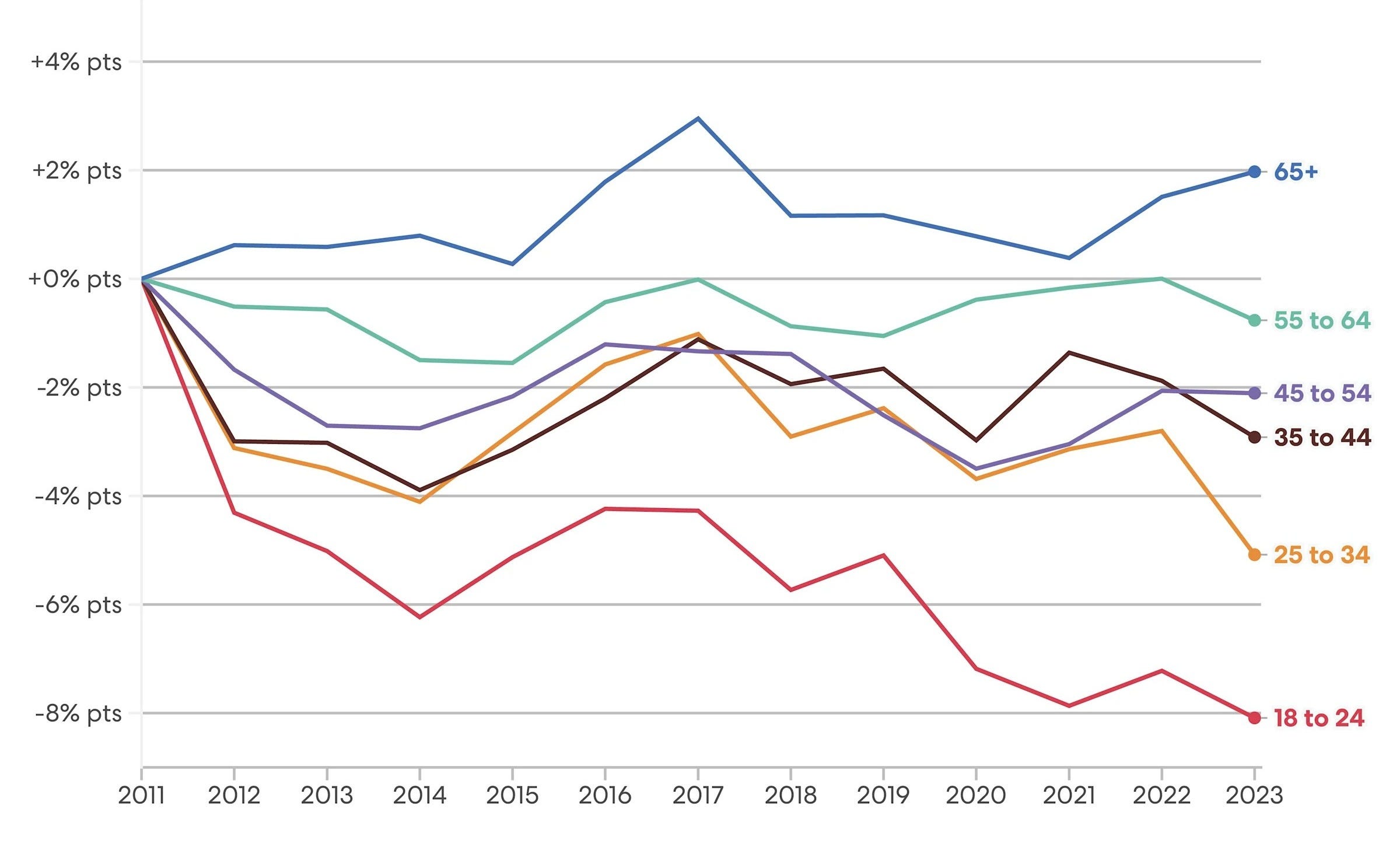
Across the world, alcohol consumption is also declining. In the United States, only 54% of adults now say they drink, the lowest share in Gallup’s nearly 90-year trend. Average weekly consumption has fallen to 2.8 drinks, the lightest since 1996. Among Americans under 35, the share who drink dropped 9% from 2023. In Silicon Valley, in particular, sobriety is even more extreme and has even become a form of credentialing among founders and early-stage teams—a signal of being locked in, working 996, and in permanent grind-mode.
Perhaps the biggest contributor is that millennials and Gen-Z’ers increasingly believe that drinking is bad for health—a trend that has also taken an extreme form in Silicon Valley with peptides, pagan diets, and even blood transfusions becoming increasingly common. Young people in China similarly cite health and emotional wellbeing as driving their retreat from alcohol. Health has for me been a big reason I have started to drink less. Like many in my social circles, I have been persuaded by one well-researched NYT piece after another that there is no safe level of alcohol consumption. Even a single serving, they now say, poses a health risk
It may be correct that sobering up has unequivocal health benefits, but drinking was never only for fun. Drinking can also influence a country’s capacity for commerce—and even innovation—acting as an infrastructure for informal and serendipitous encounters, strengthening relationships, or establishing them where they don’t yet exist. And in places where markets are weak and prone to failure, it can lubricate the gears of commerce, creating trust across buyers and sellers in otherwise low-trust societies.
This, in fact, was what that Guiyang dinner was all about. Throughout the evening, one refrain kept repeating itself in one form or another at nearly every toast that was made: Let’s not talk business! Today is about having a good time and building trust. Insisting on not talking business, however, was essential for doing business.
Weak ties and informal networks
When we think about critical inputs to innovation, alcohol is hardly one that comes to mind. Yet it turns out drinking can be quite useful because it produces informal networks among people who would not otherwise interact while also lowering the social cost of initiating such interactions so that serendipitous, cross-disciplinary encounters can happen. The reason informal networks (and hence drinking) is good for innovation is because new discoveries are more likely to occur when different kinds of information collide unexpectedly. And drinking establishments are extremely suitable settings for producing exactly that kind of collision—informal, non-hierarchical, and indifferent to the professional silos that otherwise keep most people talking to the same people most of the time.
Sociologist Mark Granovetter’s canonical 1973 paper showed that the most valuable information and opportunities in social networks tend to come not from close friends but from loosely connected acquaintances. A network of weak ties thus circulates information—and generates innovation—far better than one with fewer but stronger ties. This is what he called the strength of weak ties, also what he titled the paper.
There is compelling evidence of a positive relationship between drinking and innovation. As the US imposed Prohibition Laws in the early 20th century, it staggered its deployment county by county which made for a great natural experiment for testing the effects of alcohol consumption on innovation. Looking at the number of patents filed in each county in the year after bars were forced to close down, economist Michael Andrews found that counties saw 13-35% fewer patents after going dry with the effect peaking 2-3 year after the ban.
For Silicon Valley, drinking has also played an important role. In the 1950s, Hewlett-Packard famously held Friday afternoon beer gatherings—known as “beer busts”—to encourage cross-team conversations. At these gatherings, engineers working at different corners of the office would discover they were solving adjacent problems and combine efforts, reducing the bureaucratic inefficiencies that came with large corporate firms.
Another example is the Wagon Wheel bar—located in Mountain View and close to an emerging cluster of startups, established firms like Fairchild Semiconductor and Intel, as well as Stanford University. As this region emerged as a national hub for technology in the 1970s, the bar became the go-to meeting spot for engineers (sometimes from competing firms) who drank there together after work. Some of these exchanges led to new ventures. Others helped push new technical breakthroughs. For the semiconductor industry, the bar was especially productive. As Robert Graham, one of Intel’s founding engineers, explained:
One of the reasons that [semiconductor firms] were able to really climb [was because] only one company solved each problem. [Employees] went to the Wagon Wheel after work—they got drunk and they bragged about it, told everybody [...]. So very quickly, as a problem arise in semiconductors, it was resolved. Because all these companies were working on it, and when one of them found the answer, they all stopped working on it. They all did that, and they went to the next [problem].
That’s why it out-distanced the East Coast, because you didn’t find that on the East Coast. They didn’t have this energy. These guys were all competitors and they fought like hell, but they all drank together, and they were all young and they all liked to brag about what they were doing. In many cases, they just exchanged information, because they felt it was better to get the damn problem behind them, get some help, and then when they got help, they gave help the next time.
While not focused on alcohol consumption, the scholar AnnaLee Saxenian made a similar comparison between Silicon Valley and Boston’s Route 128 corridor in her landmark book, Regional Advantage. Despite having comparable technological starting points, Silicon Valley far outpaced Boston between 1975 and 1990, generating three times as many new jobs and growing 25 times faster over that period. Her explanation for this was that—unlike Route 128 which was dominated by secretive, self-sufficient, and hierarchical corporations that kept knowledge tightly internalized—Silicon Valley had a dense and porous ecosystem of informal exchange, across firms and disciplinary lines. In other words, it had, in Granovetter’s terms, a web of weak ties—and bars like the Wagon Wheel was of the primary reasons why Silicon Valley could weave such wide webs.
Building trust in a low-trust society
In developing countries, drinking has another important function. Where property rights and contract enforcement is weak or absent, alcohol can also enable market exchange. Consider doing business in a lawless society. Without courts to enforce contracts of law enforcement to punish fraudsters, the fundamental problem for commerce becomes one of credibility. How do you know that the stranger across the table will deliver what he promises, especially if the terms of exchange extends long periods or long distances?
In developed countries, strong contract enforcement, effective legal systems, and robust property rights protections create trust between economic actors. In these high-trust societies, risks are low. I could sign a contract with a complete stranger knowing that if the contract were breached, the legal system would make me whole. Lacking these strong institutions, market exchange between strangers can feel much riskier. But this hasn’t stopped people in developing countries from finding other ways to build trust where it doesn’t otherwise exist… like drinking.
The dinner banquet in Guiyang was an example of this. At this dinner, alcohol was the mechanism through which the distributors, buyers, and sellers at the table built fast trust with each other. In this particular case, the seller was based in Shenzhen and needed a local distributor he could trust with handling his product and getting it placed in the best supermarkets. Guiyang, we must remember, is not Shanghai. It is the provincial capital but in one of China’s least developed interior provinces, and so we should expect that the city’s legal capacity is comparably thinner than those in China’s coastal cities. For the unfortunate host who ended up in the hospital, drinking was simply part of his job—a way to signal trust in a low-trust business environment.
A 2024 paper in Public Choice titled “Till We Have Red Faces” documents the unique role that drinking has in enabling market exchange in China. Heavy drinking at Chinese dinner banquets, the authors found, is all about signaling trustworthiness to potential business partners. An untrustworthy partner would avoid drinking because intoxication risks exposing their deception. Only someone with nothing to hide could safely drink to the point of complete vulnerability.
Drinking in fact plays a similar role in much of the developing world which, lacking strong institutions, tend more often to be low-trust societies. In Russia, vodka has similarly been used as a social catalyst for building trust and sealing deals. In Vietnam, sociologist Kimberly Hoang wrote about how nightlife plays a critical role in the channeling of foreign investment from places like Japan, South Korea, and China.
Within China, drinking is also culturally embedded in some of the country’s most innovative firms. Huawei and Alibaba, for instance, have both developed reputations of having heavy drinking cultures. In Eva Dou’s recent book on Huawei, she documents how long-time employees have developed a range of alcohol-related health problems from years of company drinking events. In these companies, where success depends on navigating government relationships, supplier networks, and countless partnerships, boozy banquet dinners have long been used to establish the trust needed to partake in long-horizon, high-risk innovations.
As we saw above, drinking—especially among younger generations—is a declining trend. What does innovation look like in an increasingly dry society? Will the locked-in founders who are swapping alcohol with strict health regimens and 996 working hours be as inventive as those that came before?
As the subtitle of this post might suggest, sobering up might cost us our innovation. This was, admittedly, a bit of a click-bait subtitle. As I have argued, I do believe that alcohol has the ability to promote stronger informal networks which in turns promotes innovation, but there are too many variables at play. In the end, I suspect that we won’t see any meaningful correlation between the sobriety trend and less innovation, at least not in any meaningful way—and that’s not because tech bros are locking-in their 996 schedules in lieu of drinking.
Alcohol is, after all, just a social lubricant and we have many other substitutes for it. Cafes and board game rooms, increasingly popular in places like Boston and San Francisco, create some of the same social exposure that a bar might. That SF is back—as many (including Jensen Huang) have said in the past two years, spurred in large part by the AI boom—is good indication that even with less alcohol, the tech hub is finding new ways to build back its social scene after droves of tech workers left during Covid. Andrews’ Prohibition-era data showed that the initial drop in patent count was only temporary with rate rebounding to pre-ban levels within about five years. Technological and scientific communities, it seemed, were perfectly capable or rebuilding social networks, just without the alcohol.
Certainly for non-economic reasons, drinking less is not a mistake. Trading one’s health for innovation makes little sense. Culturally too, drinking at settings like the one in Guiyang, can often come with coercive dynamics. In China, such banquets have in fact long been a place of deep misogyny. Women are often excluded from such events where much of the consequential business exchange happens. And where women are included, they risk becoming the target of sexual harassment—and in some cases even assault. This became a national issue in China just a few years ago when a female Alibaba employee was raped at a dinner banquet by her manager during a business trip.
Perhaps the sobriety trend will force something long overdue: a more deliberate, and more inclusive, reimagining of how trust and networks are built in professional life. The bar and the banquet, for all its utility, was never a neutral space—it excludes, coerces, and harms, and almost always in gendered ways. If its decline pushes us to find better venues for the informal exchange that drives collaboration and builds trust, that is not a loss for innovation. It may even, in the longer run, turn out to be a quiet gain.
I recently finished teaching an undergrad course on international development and technology where, in one class, we discussed the various strategies in which economic actors in developing countries overcame weak institutions to enable commerce. Drinking, as I’ve described of the Chinese case, came up as one such mechanism, and that was partly what inspired this post. Anyway, the semester is now over and hopefully that’ll give me more time to write and post a little more frequently than I have been these past few months.
Fondly recalling the time I was invited to a rural county in Zhejiang (must have been in 2016) and was up late drinking with the county officials and the professor who brought me along to investigate rural revitalization efforts. Woke up hungover the next morning with the director of county finance (I think) banging on the door of my room. 'Andrew, lets go we need to get going to visit more projects today." Quite a memory!
Interesting take on drinking. I've seen my fair share of bars in major tech company HQs like Microsoft and NVIDIA and also at expo halls in technical conferences where business can get done. Drinking is also done as sort of a team bonding ritual by high performing teams working on challenging problems.
At the same though, I do have the play devils advocate that people can drink as an escape from the stress and burnout at work. Which begs the question: do people drink to escape work to help with work?