
China's missing ecosystem
Where is the country's software ecosystem? And what are the costs of not having one?


From across the political spectrum, and certainly in Silicon Valley too, there is growing envy of China’s industrial capacity. This envy is not surprising: the US has for decades now struggled to build things. Ezra Klein and Derek Thompson—and since their book, a chorus of America-can’t-build critics—have written about this problem. And there are many reasons why. Klein and Thompson say the problem is government red tape; Dan Wang says its America’s lawyerly (rather than engineering) society, etc. But what no one seems to disagree on is that the country is in large part missing the industrial ecosystem for building things. Indeed, what China has, that the US clearly doesn’t, is precisely this.
China does have a robust industrial ecosystem which has no doubt given the country an important advantage in being able to build quickly, at scale, and at ever cheaper costs. But what these critics of the American context tend to overlook is that China, too, is missing a critical ecosystem that the US has in abundance—and, in fact, one that many Chinese themselves envy: a software ecosystem.
Let me explain. There is no doubt that China has great tech companies—Tencent, ByteDance, Alibaba, to name a few. But virtually all of them have built their digital empires on consumer-facing services: delivery platforms, online retail, messaging apps, and the like. Puzzlingly, what is missing are enterprise software and SaaS giants—the building blocks of a thriving software ecosystem. China in fact seems to have no counterparts to companies like Oracle, Databricks, Snowflake, or Stripe.
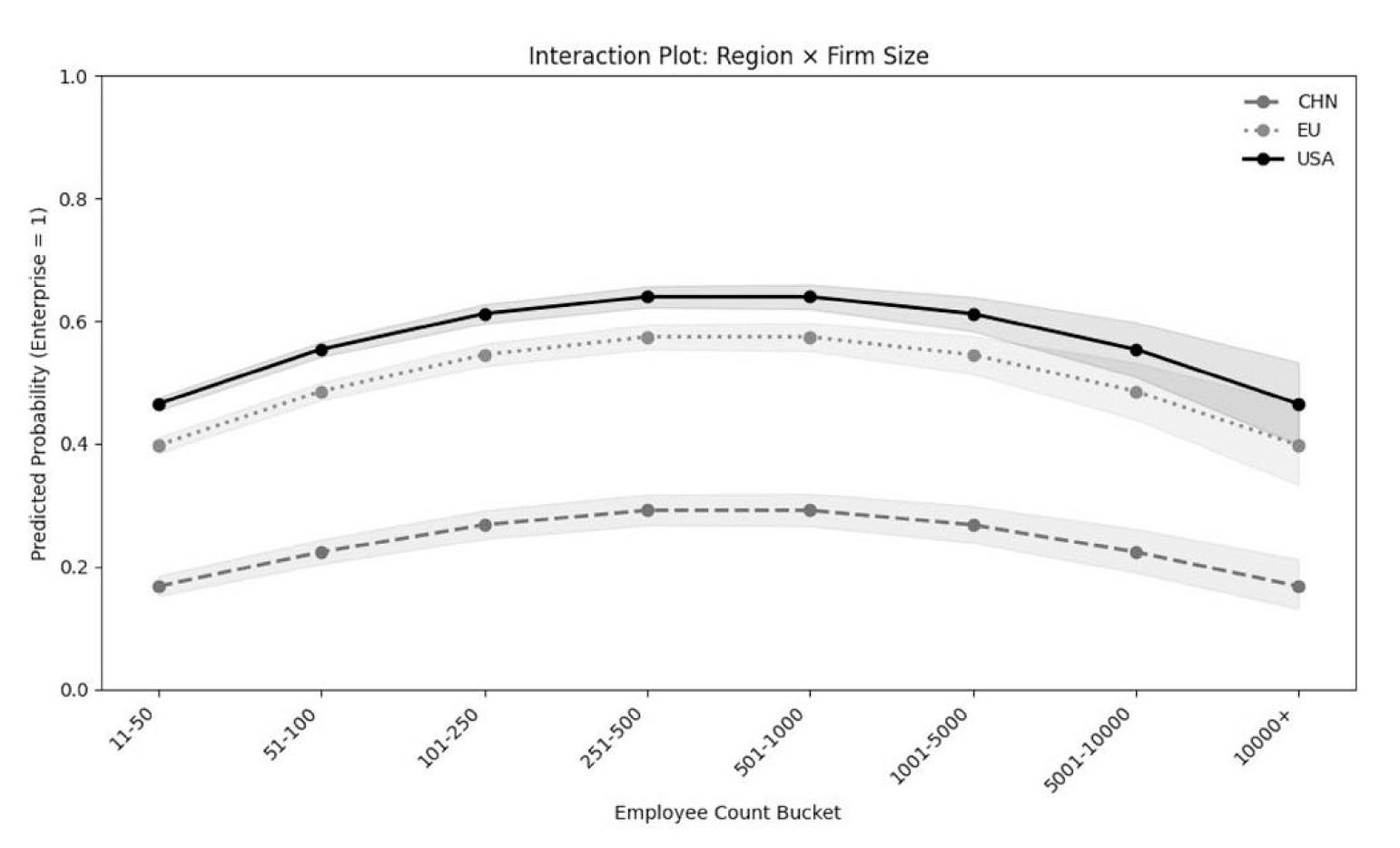
Despite the size of its digital sector and access to plenty of software talent, the development of the Chinese tech sector has indeed taken a very different path, and this is what I show in a new paper published earlier this month in Industrial and Corporate Change where I analyze over twenty thousand tech companies founded between 2000 and 2020. My key empirical finding is that, between consumer-facing platforms and the kind of enterprise-facing ones you would expect to find in a dynamic software ecosystem, tech companies in China are 76% less likely to be in the latter category when compared to their American counterparts (graph on this below).
What explains this? My paper spends a significant amount of time with exactly this question so I’ll encourage you to read it (dm me for the pdf since it is behind the paywall). For now though, what I’ll say is that China’s political economy makes for a uniquely inhospitable environment for such enterprise software and SaaS companies. At its core, the business model underpinning these enterprise software/SaaS requires longterm inter-firm relations because, unlike consumer platforms, most of their revenue comes from far fewer customers to whom they provide much deeper services. However, these longterm relationships require trust, and China is in short supply of that.
Many companies do not trust third-party software providers with their data, which they consider a source of competitive advantage. State-owned enterprises, which account for a substantial share of enterprise software demand, are especially resistant because they have more stringent data security requirements.1 Chinese businesses can also be quite skeptical of enterprise software providers whom they believe tend to cheat customers for more money than the value they actually provide. And so, to get a good deal, businesses will often squeeze software vendors, asking them to work for free under the guise of proof-of-concepts; or demanding post-sales work such as maintenance of additional features for free.
At the core of this is a deep-rooted belief that software is not a productive investment but simply a cost to minimize. And so, wherever they can, businesses will internalize the cost of software by hiring budget engineers to develop solutions at much lower costs. This, of course, is only possible because of the large supply of inexpensive engineering labor in China.
So why does having a good software ecosystem matter? What do these enterprise SaaS firms do that consumer-platforms don’t? The key difference is that consumer platforms are users of existing technologies, whereas enterprise software/SaaS firms are far more likely to compete on the technology itself. To be sure, this latter category is a broad one, and it includes companies like Workday and Salesforce whose products are about combining some domain expertise with existing technology (e.g., Workday combines task management knowledge with software). But it is this same category of enterprise software and SaaS that houses the firms whose products are the underlying technology—and thus make up the building blocks of a robust software ecosystem. For instance, Snowflake’s technical contributions to data management far exceed Uber’s “innovation” of centralizing taxi dispatch, which is more about arbitraging regulatory gaps than any actual technical innovation.
This is not to say that consumer platforms do not innovate at the technology layer. Companies like Google will often develop new technology to improve some aspect of their consumer business, and in doing so will advance the frontier of a particular domain of software. But such cases are few and far between and tend only to come from the largest and most sophisticated consumer platforms.
Moreover, and quite unlike consumer platforms who compete on network effects (which depends more so on execution speed), firms within a software ecosystem exist in a web of complementarity where each firm becomes more valuable precisely because of another firms’ membership. In other words, rather than focusing on speed and costs, these firms cooperate and interoperate even as they (at times) compete with one another, pushing each toward deeper (if nicher) technological innovations.
Its no surprise then that the US tech sector, with its robust software ecosystem, has been the defacto breeding grounds for important advancements in the field of software. To name a few, these include Apache Spark, the most popular software for large scale data processing; Docker, the standard for reliably deploying software to the cloud; and Kubernetes, the go-to technology for orchestrating and automating complex software deployments. This amalgam of mostly US firms is, in some ways, perhaps the software equivalent of Shenzhen’s industrial ecosystem.

It is hard to know what these differences will mean when it comes to AI. But as foundation models become commoditized and value moves up the stack, the ecosystem though which AI gets deployed into organizations become more important. And for China’s case, there’s little reason to think that the same factors that stunted its software ecosystem won’t also constrain the emergence of a rich AI one.
Meanwhile, and despite what many are calling the SaaSpocalypse in the US, some SaaS firms now seem to be best positioned to generate meaningful AI adoption for the rest of the economy. Companies like Microsoft, Databricks, Snowflake, and Salesforce can cash in on decades of enterprise trust—as well as the deep data pipelines and complex integrations—that may turn them into the default platforms on which corporate AI adoption runs.
China may have an impressive industrial ecosystem that is flooding the world with cheap but increasingly high-quality goods. But we should not forget that the US has an equally impressive—though much less visible—ecosystem, one that remains the envy of many Chinese technologists.

Super interesting read.
This put into a new light Chinas decisions around data policy in the early 2020s. I was working in data policy around the pandemic when Beijing seemed to be trying to steer the sector off the US consumer-advertising model. At the time, commentators called it choosing the “German road” over the “US road,” with hard tech as need-to-have and consumer internet as nice-to-have.
It didn’t seem like enterprise software was really on the radar at the time. Further, the steps taken on data policy may have exacerbated the points you bring up, as it then also became more legally risky to share data (this specific narrow point, rather than the broader point on ecosystem growth was already being made at the time)